
原文由 Vincent Cheng 撰寫,刊於其 LinkedIn Pulse(2026年11月5日)。經作者授權轉載於《好。報》。圖片及觀點屬原作者所有。
Impact investing brings together people with different goals and expectations. Some see it as a way to pursue financial returns while addressing social and environmental challenges. Others approach it as an extension of philanthropy, using investment to sustain and recycle capital for impact.
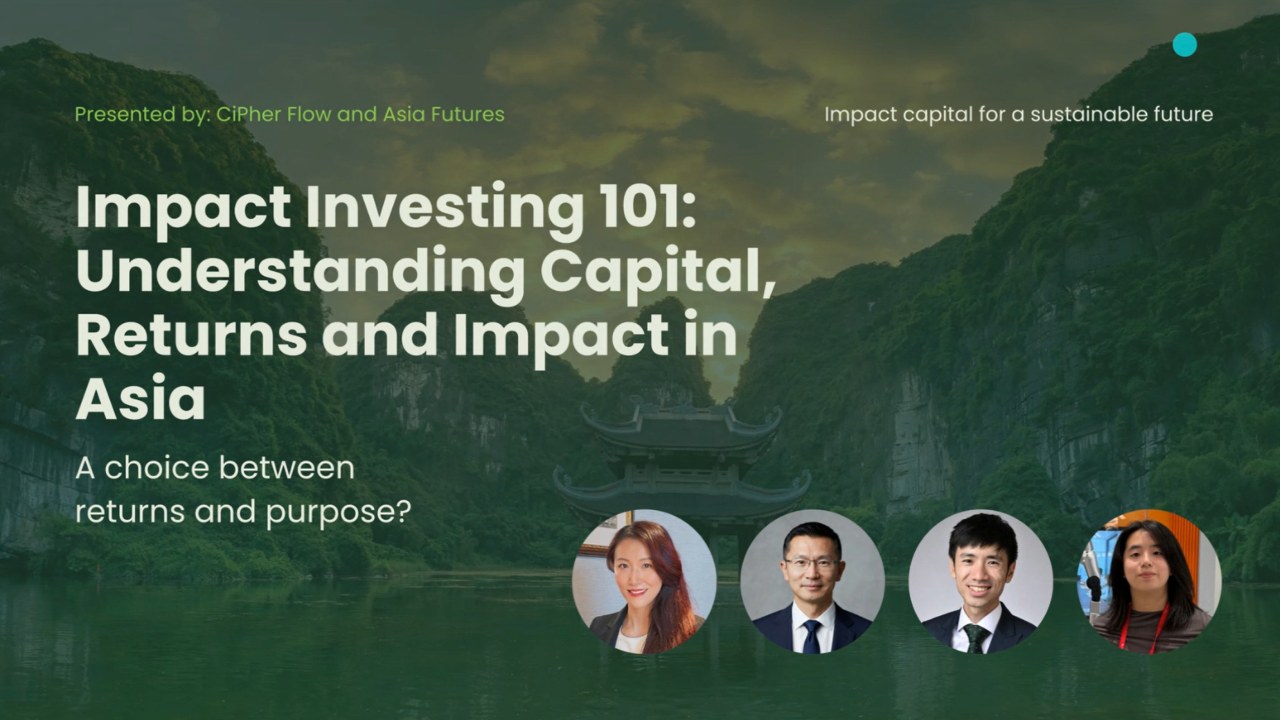
Those differences became the central thread of Impact Investing 101: Understanding Capital, Returns, and Impact in Asia webinar, co-hosted by Asia Futures and CiPher Flow on October 22.
Ka Cheng Chan, Founder of CiPher Flow, shaped and moderated the conversation around a practical question: is impact investing necessarily a trade-off between financial return and purpose? Her questions brought the discussion beyond definitions to how investors assess opportunities and support founders.
A shared definition, different expectations
Vincent Cheng, Founder of Asia Futures, opened with a framework: impact investing intentionally seeks measurable social or environmental outcomes alongside a financial return. But that definition leaves room for different approaches, from impact-first capital willing to accept below-market returns to strategies targeting market-rate returns.
The practical question is therefore not simply whether to become an impact investor. It is what kind of capital, time horizon, and risk appetite an investor brings, and where those resources can be most useful. That is the question Asia Futures helps next-generation leaders explore, with a focus on climate, health, and AI’s impact on education and employability in Asia.
Climate and food: investing in an ecosystem
Tao Zhang, Co-Founder of Dao Foods International, Inc., offered a candid perspective from its work investing in alternative-protein ventures and helping develop the market in China. He cautioned against presenting impact investing as a straightforward route to maximizing financial returns. In his view, it is better understood as an extension of philanthropy: a way to pursue public benefit, generate reasonable returns, while getting capital back to recycle.
At Dao Foods where a blended finance approach has been taken, that mission centers on climate, environmental protection, and animal welfare, with impact maximized and financial return treated as the bottom line. Tao’s approach rests on three Ps: product, policy, and people. Appealing products need supportive policy implementation and consumers who understand the proposition, which is why the portfolio includes media and trading businesses as well as product companies. The aim is an ecosystem centering around entrepreneurship and companies that support one another and help the sector grow.
Health tech: aligning impact and commercial value
Scarlett Chen 陳思佳, Managing Partner of Verge HealthTech Fund, described a fund built on “two bottom lines”: financial returns and social impact. On a wider spectrum of capital which runs from donations and grants to commercial investment, Verge is on the commercial investment end. In health tech, she said, the two goals can reinforce each other: technology that reaches more people affordably tends to be a stronger business too, though not everything in healthcare is automatically impactful.
Asked by Ka Cheng how working with founders differs across regions, Scarlett said experience varies widely everywhere. In Silicon Valley, she said, many founders have practiced or have watched others around them build companies. In hubs like Hong Kong and Singapore, which have strong academic research, she sees more researchers building their first companies and often lacking experience in how to build a business, so the support they need runs wider from preparing a pitch deck to commercialization.
The takeaway: make expectations explicit
The conversation revealed more than different investment strategies. It showed that experienced investors can hold different views about what impact investing should mean.
Tao positioned his work as impact-first, while Scarlett described Verge as pursuing financial returns and impact together. Both are credible approaches, and they ask different things of the people providing the capital. The discussion made a case for clarity: before investing, be explicit about the outcomes you want, the return you expect, and the trade-offs you are willing to accept.
Where does your own capital sit on that spectrum?
Originally published on LinkedIn Pulse (5 Nov 2026).