

What the SVhk–Sino Impactathon reminds social entrepreneurs, NGOs and funders about learning with communities before scaling.
When a new district rises on the map, the first instinct is often to ship technology into it.
Hong Kong’s Northern Metropolis is exactly that kind of temptation: growth corridor, university and I&T ambitions, ageing and youth needs arriving in parallel. The question for social innovators is not whether apps and sensors will show up. It is whether anyone has earned the right to design them.
On 29 September, Sino Group and Social Ventures Hong Kong (SVhk) published the close of their ‘SVhk-Sino Impactathon’ — and the sequence they chose matters more than any single trophy.
Listen first, then demo
Unlike a conventional start-up contest that rewards a polished deck on day one, the Impactathon ran for five months beside seven community partners. Teams worked with residents and stakeholders across the Northern Metropolis — children, youth, underprivileged families, older adults, rehabilitation service users — more than 1,000 people in direct engagement, according to the organisers. Support came from the Northern Metropolis Co-ordination Office, Hong Kong Science and Technology Parks Corporation, the Jockey Club Design Institute for Social Innovation at PolyU, and entrepreneurship platforms from six local universities. More than fifty partners in total.
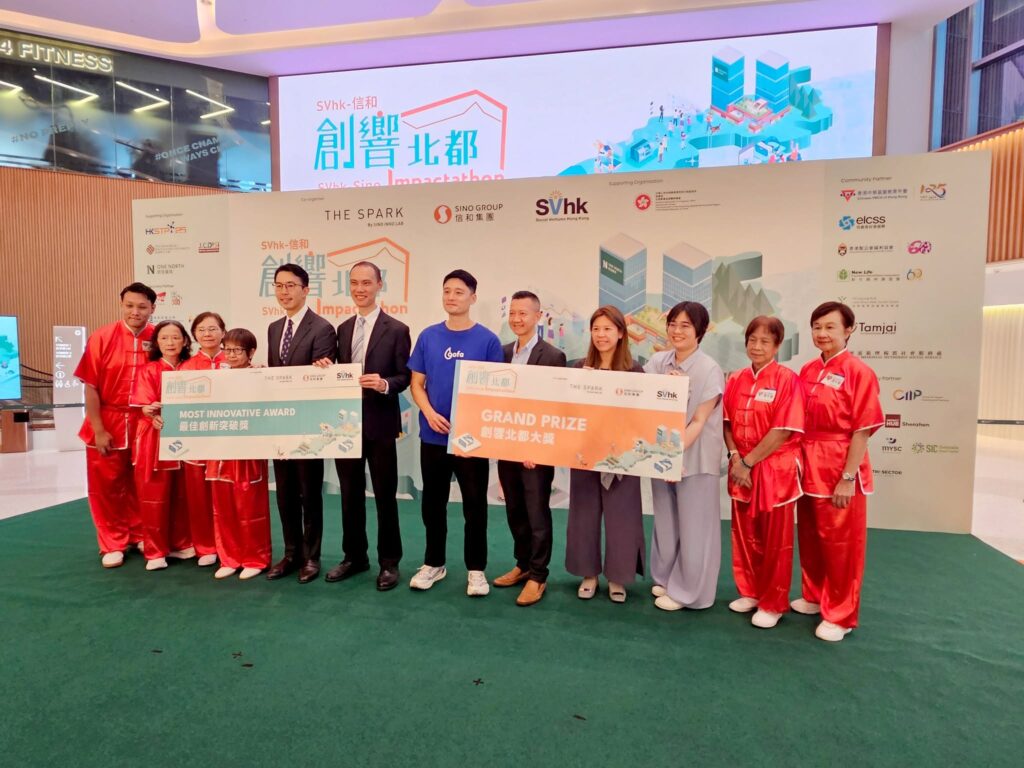
Only then did eleven teams present pilots at One North in Yuen Long. Seed funding of HK$200,000 went to winning teams. GOFA took the Grand Prize and Most Innovative Award for AI-powered health risk assessment; Mapcraft took Most Community-Driven; Singapore-based N&E Innovations took Most Scalable Builder. Technologies on the table included AI, GIS, biotechnology and food tech — aimed at older adults’ health and fall-risk prevention, youth learning, and family well-being.
That is not a cosmetic change to Demo Day. It is a product decision about when community knowledge enters the build.
SVhk’s Francis Ngai put the systems framing cleanly: community making needs hardware and software infrastructure. As physical Northern Metropolis infrastructure takes shape, community infrastructure — listening, collaborating, testing with frontline organisations — has to keep pace. Sino’s David Ng made the parallel point from the developer side: the value of innovation is not technology alone, but whether it improves people’s lives.
For those of us building social ventures, and those of us championing them, in Hong Kong and the GBA, this is the lesson to back: community discovery is not a warm-up act. It is the product surface.
The same month, a wider pattern
Three other public signals from September land next to that sequence.
Greater China recognition. On 29 September 2026 the Schwab Foundation named its 2027 Awards finalists: 21 organisations across 17 countries, including two Social Entrepreneur finalists from Mainland China. One is Weihao Xu’s Xishi Magic Bag, a marketplace that helps food retailers sell surplus stock in discounted packages rather than discard it. Winners come later, ahead of Davos 2027, but the lesson is already there: the interesting work changes the systems around a problem, not only the venture story.
Chinese-language ecosystem: social weight on the scoreboard. On 7 September, 社企流 (SE Insights) and 活水影響力投資 hosted their NPO innovation accelerator’s corporate matching day in Taipei, with 天下永續會. The operational hook for enterprises: Taiwan’s upgraded ESG evaluation system takes effect 1 October 2026, with the social pillar rising to 31% of the score — from historically as low as 9% — and exceeding the environment weight. SE Insights’ Lin Yi-han argued that NPOs are not waiting rooms for CSR cheques; they are the field partners who already hold issue insight and community trust. That translation problem — KPI language versus accompaniment language — will sound familiar to any Hong Kong NGO that has sat across from a corporate sustainability team.
Measurement without judgment. Earlier in September, Shared Value Initiative Hong Kong’s ReThink HK Impact Stage panel (“The Tyranny of the Measurable”) warned that dashboards can flatten strategy. PolyU’s J.C. DISI work on all-age inclusive community assessment was cited as pairing district data with lived experience — a neighbourhood can look “covered” on paper while older residents still cannot reach the service. Metrics remain necessary. They are a tool, not the destination. Discovery done badly produces beautiful KPIs about the wrong problem.
Different instruments. Same sequencing demand: learn with communities before you scale the story.
What social entrepreneurs still under-price
As a social entrepreneur, and as someone who advocates for social innovation in Hong Kong, I see the same thing again and again. The teams that struggle are rarely short of compassion or slides. They are short of a sober map of:
- Who was in the room before the pilot? Resident, carer, frontline NGO, district partner — or only the incubator WhatsApp group?
- Which community organisation will still refine the build after Demo Day? Accompaniment is a delivery channel, not a logo on the poster.
- What evidence is resident language versus dashboard language? Escort demand, fall-risk fear, after-school nowhere-to-go — these are design specs.
- What survives when the seed cheque is spent? Training kits, referral pathways, and trust do not auto-renew with a press release.
HKSEC 2026–27 — now in its twentieth year, enrolment open through 26 October 2026 — will put another cohort of young social entrepreneurs through that discipline. Mentors and judges should look as hard at community discovery as they do at unit economics.
Closing
Hong Kong does not lack social-innovation energy. What it often lacks is the humility to treat community discovery as core product work — especially when the map is redrawn and the temptation to “drop tech in” is strongest.
The Impactathon’s contribution is not only HK$200,000 in seed money. It is a public reminder that residents and community partners are co-authors, not a late-stage validation slide. Pair that with a region where ESG social weight is rising, Schwab-recognised models are changing how surplus and access work, and measurement debates are getting sharper — and the case for putting communities first makes itself.
Curious what others are seeing: where in Hong Kong or the GBA are we still shipping the demo before we have earned the listening?
Sources
- Sino Group — “Sino Group and SVhk Connect Start-ups with Northern Metropolis Communities Through ‘Impactathon’” (PR Newswire), 29 Sep 2026
- World Economic Forum / Schwab Foundation — “Meet the 2027 Schwab Foundation Awards finalists”, 29 Sep 2026
- 社企流 SE Insights — 「首屆 ESG 評鑑上路,社會面成新戰場!2026 NPO 加速器企業媒合會」 (matching 7 Sep 2026; ESG evaluation from 1 Oct 2026)
- Shared Value Initiative Hong Kong — “ReThink HK 2026 | The Tyranny of the Measurable” (blog 22 Sep 2026; event 10–11 Sep)
- CUHK Business School — “HKSEC 2026-27 is kicking off! Enrol Now!” (enrolment to 26 Oct 2026)
- Hong Kong Social Enterprise Challenge official website
- StartmeupHK — “Hong Kong Social Enterprise Challenge 2026-27”
First published on LinkedIn by Albert Au, 30 Sep 2026. Read the original post on LinkedIn.
