

Original article by Eugenia Lo (with original contributions from Vivica Xiong), published in the STEP Hong Kong Branch Newsletter (Summer 2026). Republished on 《好。報》 with permission for review. Views belong to the original author(s).
Traditional data sources often focus on direct giving trends in Hong Kong. One trend which is beginning to attract attention among funders is how philanthropy can fuel small to medium non-profit organisations to scale their impact via capacity-building.
This article discusses what effective capacity-building means for small to medium non-profit organisations in Hong Kong and why this continues to be an urgent issue in our local ecosystem. It also examines how forward-thinking philanthropists can contribute to catalyze effective philanthropic solutions.
What does capacity-building mean?
Local perceptions of capacity-building vary, due to different interpretations of what ‘capacity’ means. Formally, United Nations Academic Impact defines ‘capacity-building’ as ‘the process of developing and strengthening the skills, instincts, abilities, processes and resources that organizations and communities need to survive, adapt, and thrive in a fast-changing world.’
Despite this definition, capacity-building is often simply a local synonym for training or learning and development of individuals or organisations. Offerings usually follow a generic formula:
- coaching or mentoring individuals;
- ad-hoc technical or function-specific workshops;
- themed conferences; and
- referrals to network contacts (at best).
As a result, this generic association has over-shadowed the critical importance of effective capacity-building to non-profit organisations, especially under-resourced and smaller non-profits. Hence, giving to capacity-building is often not visibly discussed among philanthropy stakeholders, essentially leading to overlooked gaps in how non-profits scale their impact and attract funding.
What are the key gaps in capacity-building in Hong Kong?
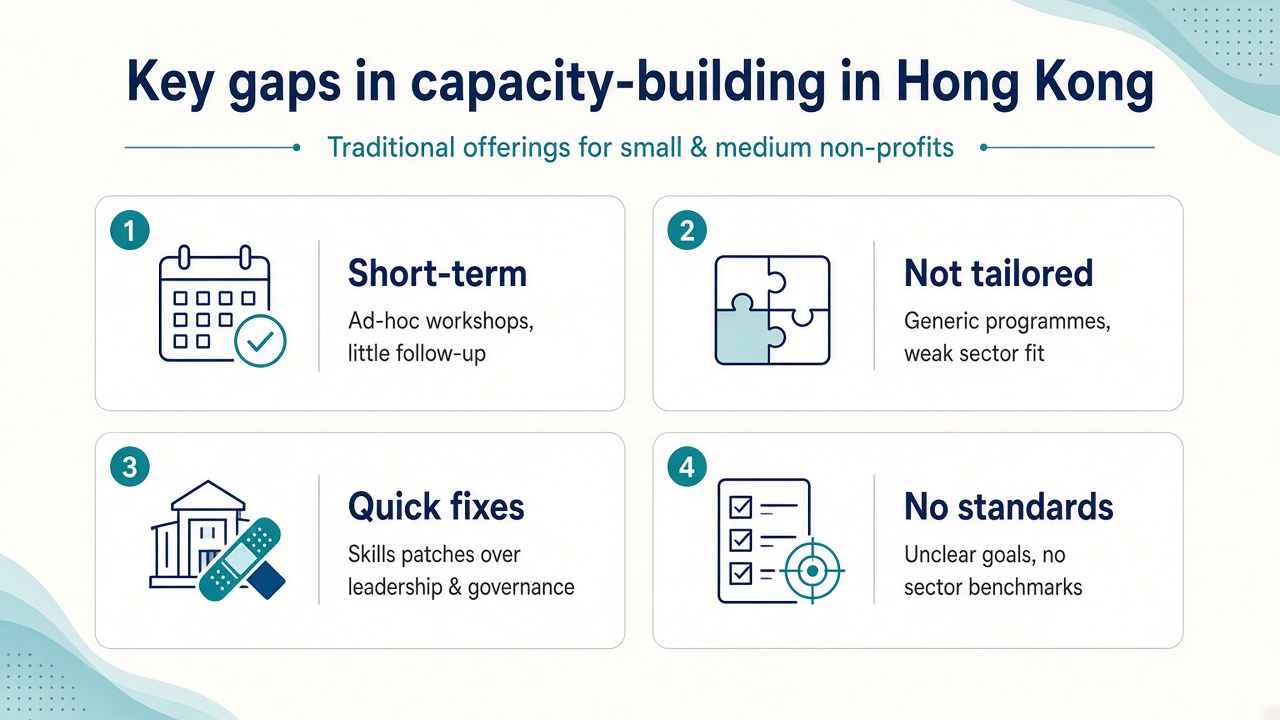
Traditional capacity-building in Hong Kong can be simply characterised as:
- Short-term: an overemphasis on ad hoc, event-driven training rather than sustained development. Standalone workshops and seminars dominate without structured or consistent follow-up actions after each workshop or seminar ends. This design is generally attributed to the non-profit organisation’s existing funding limitations, for example, finite funding life cycles or capacity-building as an after-thought in the original programme design.
- Lack of tailored solutions: a ‘one-size-fits-all’ mentality that fails to address unique sectoral context and organisational needs. Capability and capacity constraints within the non-profit service provider only motivates the provider to focus on providing the most convenient options, such as event-driven training.
- Quick fixes over institutional strengthening: the focus on immediate technical skills rather than cohesive systemic capacity (coherent leadership, governance, digital transformation and strategic planning). If capacity-building is only seen as a quick fix to a hot-topic issue, capacity-building curators will be inclined to only address the most obvious skills gaps, such as AI technical skills.
- No benchmark on sectoral standards: there is often no upfront clarification of specific capacity-building goals and objectives and no or little discussion of how these goals/objectives are relevant to the capacity-building recipient.
Are there no innovative approaches to funding capacity-building?
The above legacy deficiencies have encouraged a small group of funders to recognise the urgent need to revamp local capacity-building offerings as a way to scale impactful non-profits. Derived from publicly-available information, I am highlighting three selected innovative approaches that continue to lead to impactful outcomes.
Non-profit capacity-building intermediaries
Well-established non-profit capacity-building intermediaries (for example, Asian Charity Services and Foundation for Shared Impact) either work with local social purpose organisations or beneficiaries. These intermediaries offer capacity-building via structured training workshops, bespoke consultations or individualised mentoring and free resource-sharing and matching.
Capacity-building intermediaries focus on meeting their beneficiaries where they are in their development stage. At the same time, they engage professional and skilled volunteers in consultations with non-profit participants which can offer volunteers access to different perspectives.
Operational grants for non-profits
During the COVID-19 pandemic, a small pool of family foundations accelerated capacity-building giving (case studies). Since then smaller grant makers have continued to offer smaller operational grants including the Resolve Foundation’s participatory grant and HER Fund’s operational fund.
The Hong Kong Jockey Club Charities Trust launched its 2024 initiative, ‘Jockey Club Broadening Outreach Scheme’, a multi-year scheme created and funded by Hong Kong’s perceived largest donor. It aims to support eligible smaller non-profit organisations with tailored capacity-building, access to relevant networks and the opportunity to apply for a relatively sizeable organisational development grant. This launch potentially signals a pivot for the local funding landscape to expand from traditional grant giving.
Capacity-building curriculums
Cross-sector co-creation of multi-year capacity-building curriculums has also become the norm. An example of this is the joint Sustainable and Social Innovation Leadership Programme created by the University of Hong Kong and UBS (ssilp.hk). The initiative aims ‘to nurture current and future non-profit leaders to enhance the effective functioning of non-profit organisations’.
Structured to offer ‘theoretical knowledge backed by academic literature, case studies and discussions, as well as exchanges with experienced professionals from the field’, the UBS collaboration ‘targets to add insights from the financial field into the programme to elevate fellows’ understanding and positioning with financial knowledge [and] with opportunities to connect with leaders from the Greater Bay Area cities’. Originally set up in around 2023, the website showcases more than 70 projects formed through this initiative.
What can we learn from these approaches?
The argument for capacity-building funding is no longer new in Hong Kong’s impact ecosystem. Capacity-building funding initiatives exist, as can be seen in the three illustrative approaches above, however these are not mainstream. Acceptance and adoption is still fragmented or implemented in silos.
Observations point towards actionable recommendations for philanthropists/private funders that not only apply to our local ecosystem but can also resonate with a regional/international audience. These are:
- increasing funding with a focus on sustainability and shift from short-term grants to multi-year capacity investments;
- leveraging intermediaries by supporting NGOs, sector specialists and networks to design context-sensitive programmes;
- impacting measurement through developing common indicators for impact (as this is a difficult field to measure);
- encouraging collaboration by fostering partnerships between government, private sector, and civil society for shared learning; and
- creating standards through showcasing roadmaps of what success look like for capacity-building.
— Eugenia Lo
Advisor for private foundations
With original contributions from Vivica Xiong, former CEO, Asian Charity Services
